Building an Offline-First Tactical Operating System for the DDIL Battlespace
Dalton Casto
Jul 10, 2026
Seeking one veteran co-founder with operational experience in C4ISR, tactical logistics, communications, or special operations to help validate and build the next generation of offline-first tactical software. If that’s you, I’d appreciate ten minutes of your time.
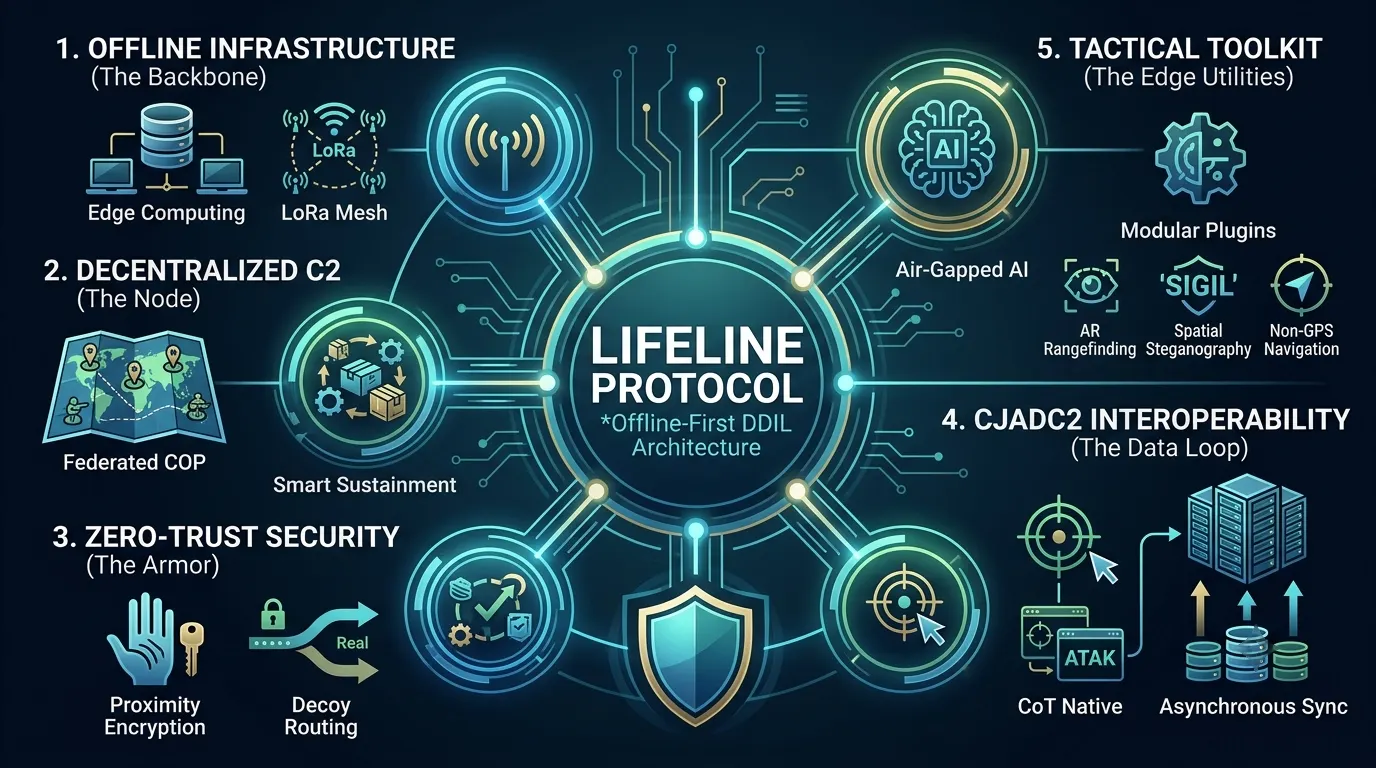
Lifeline Protocol Simplified Architecture
Every operator has experienced it. The radio drops. GPS becomes unreliable. The network disappears. The mission does not stop.
That is the environment Lifeline Protocol is designed for. Despite significant investment in digital modernization, many operational systems still depend on reliable connectivity that cannot be assumed in a near-peer conflict. The tactical edge is now a Denied, Degraded, Intermittent, and Limited (DDIL) battlespace. Service-Members need systems that operate autonomously for weeks without reach-back to a central cloud, and scale dynamically when the grid goes dark.
Why I Started Building Lifeline Protocol
My father served as an Army 19Z. While I was medically disqualified from military service, my contribution takes a different form: building technology for the people who serve.
I specialize in AI-accelerated software development focused on modular, offline-first systems. My advantage is not scale. It is iteration. I can prototype in weeks what traditional development often takes months to explore, and then rapidly iterate based on operator feedback.
Military innovation succeeds when it reduces friction. We are iterating rapidly with a singular focus on reducing operator cognitive load.
Every feature is designed to answer one question: How many seconds, radio calls, and battery percentages does this save?
What Exists Today: Prototype & Architecture Status
Lifeline Protocol is transitioning from concept to engineering validation. The core architecture is built. Functional prototypes have been validated in isolated development environments. The current state of the ecosystem includes:
- Offline Functionality: Modular micro-apps demonstrating offline operation without internet connectivity.
- Reduced SWaP: Prototype AR measurement and rangefinding tools designed to reduce physical gear weight.
- Interoperability Design: System architecture mapped for native Cursor on Target (CoT) message generation to support future ATAK integration.
- Air-Gapped Knowledge: Proprietary survival curriculum formatted for a localized, air-gapped database.
Lifeline Protocol Detailed Architecture
The C2 Beachhead & Roadmap
We are not trying to boil the ocean on day one. Our immediate beachhead is a federated Common Operating Picture (COP) designed specifically for disconnected operations.
- Decentralized C2 (The Protocol): A prototype operational cell designed to synchronize squad loadouts, tactical task assignments, and route reconnaissance offline.
- Counter-Exploitation Concept: As a planned capability, data will be protected by air-gapped proximity encryption. If compromised, entering a duress code unlocks a decoy dataset while protecting actual operational information.
- AI-Assisted Staff Work: A framework for localized AI to assist the S-shop by drafting WARNORDs and tracking granular preparation assignments weeks in advance.
- The Modular Roadmap: Once the core C2 node is validated, the ecosystem expands through modular plugins. Additional modules are already under development.
Feeding the CJADC2 Ecosystem
Lifeline Protocol is designed to integrate upward into existing defense ecosystems rather than replace them. When connectivity returns, locally collected operational data can synchronize with higher-echelon analytical platforms.
Why Now, and Why I Need an Operator
The software has reached the point where additional progress depends less on writing code and more on validating it against operational reality.
I need a translator.
I do not need military credibility borrowed from someone else’s résumé. I need someone whose operational experience will fundamentally change the product. Experience cannot be simulated.
I can build software. I cannot recreate twenty years of operational experience. I do not want someone who agrees with me. I want someone who tells me when a workflow is unrealistic, when an interface creates friction, or when a feature will not survive contact with reality.
This is a true co-founder opportunity. I am looking for someone who will help shape the company, not simply advise it. The product is early enough that your fingerprints will be on every major decision.
Over the next six months, our goal is to conduct operator-led validation, refine workflows, and unlock the defense acquisition pathways necessary to harden this system for production.
I am not looking for an advisor. I am looking for one operator who is ready to build. Someone who has spent years solving problems in the dirt and wants to build the tools they wish they had.
If this succeeds, it will not be because I built software. It will be because we built software operators actually trust.
The software is not the product. The partnership is.
Lifeline Protocol needs someone who understands how software is built and someone who understands how wars are fought. I already have one half of that equation.
If you have the other, let’s talk.
Looking for one veteran co-founder to help validate and build the future of offline-first tactical software.
Dalton Casto
Founder & Product Architect, Lifeline Protocol
Devils Lake, ND